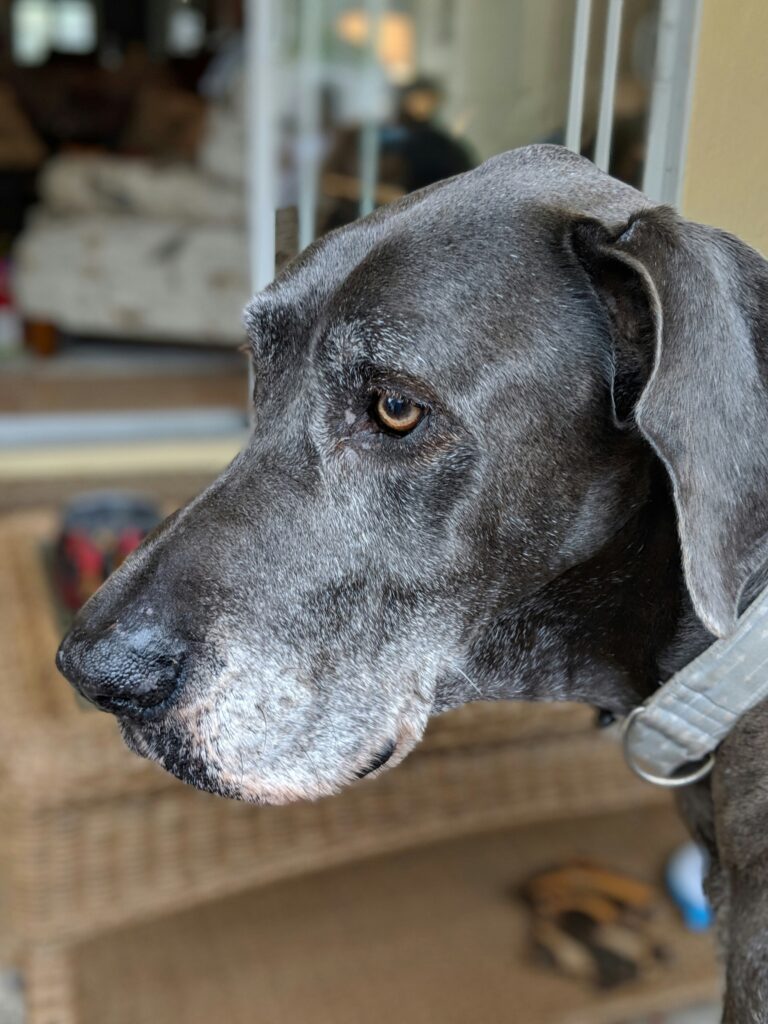
I keep paying $262.40 a month to insure a 14-year-old dog.
Most people think I’m mad. Her muzzle’s gone grey, she sleeps most of the day, and the premium is more than two and a half times what it was when she was a puppy. But I’ve never seriously considered cancelling. Here’s why, and what you need to know if you’re in a similar position, or trying to insure an older dog for the first time.
What “older dog” or “senior dog” means for insurers
Insurers don’t wait until your dog is ancient to start treating them differently. Most Australian pet insurers consider a dog senior from around age 7 or 8. That’s when premiums start climbing faster, and it’s also when your options for new policies begin to narrow.
You’ll see the terms “older dog”, “senior dog” and “elderly dog” used interchangeably by insurers, there’s no industry standard definition, and searching for elderly dog insurance turns up the same handful of products as searching for senior dog insurance. What matters is the number: most policies draw the hard line at age 9 for new applications.
If you already have cover: keep it
This is the most important thing I can tell you.
Every major Australian insurer offers what’s called lifetime cover, meaning once you’re insured, you can renew indefinitely regardless of your dog’s age. There are no age-based reductions, no forced downgrades to accident-only, no sudden cancellations because your dog turned 10.
My dog is 14 and still on the same level of comprehensive cover she’s always had. The premiums are painful, but the cover hasn’t changed.
What ends lifetime cover is a lapse. If you miss a renewal, let the policy lapse, or voluntarily cancel and try to re-apply later, you’re starting from scratch. And at that point your options are much more limited.
So if you’re reading this with an older dog already insured: do not cancel. The premium increase stings, but the alternative is trying to find new cover after age 9, which is genuinely difficult.
If you’re starting fresh with an older dog
This is where it gets harder.
Most Australian insurers set their maximum entry age for comprehensive cover at 8 or 9 years old. After that, new applications are either declined or limited to accident-only.
Here’s how the main options break down:
Pet Circle Insurance accepts new dogs up to age 9 for their standard policy. After that, no new applications are accepted. If you get in before 9, you’re covered for life with no sub-limits, one of the better policies on the market for ongoing senior cover.
PetsOnMe works on a tiered system. Their Classic and Deluxe plans (up to $20,000 annual cover, including dental on Deluxe) accept new dogs up to age 9. Dogs over 9 can still apply for the Accidental Plan, $5,000 annual cover for accidents only, no illness. It’s limited, but it’s something.
RSPCA is one of the more flexible options for older dogs. Its PetShield plan accepts new applications for dogs up to 16 years of age, well above what most insurers offer. Australian Seniors matches that ceiling on its Basic Accident and Illness cover, and Guide Dogs Basic Care takes new dogs from age 9 with no upper age limit. If you have an older dog and want illness cover, not just accident cover, those three are worth looking at seriously.
Why options narrow so sharply after 9
It comes down to risk. Older dogs are more likely to need expensive treatment, and they’re more likely to have pre-existing conditions that eat into what a new policy will actually cover.
Common health issues that become more frequent after age 7 or 8 include arthritis, cancer, kidney disease, diabetes, and dental disease. These are exactly the conditions insurers are most cautious about when assessing new applications.
Cavoodles are a good example of why early cover matters. Mitral valve disease, common in the Cavalier lineage, tends to show up as a documented murmur before age 8, which is also when most insurers close the entry age window. Our Cavoodle pet insurance guide covers the full picture.
Even if a senior dog qualifies for a new policy, pre-existing conditions are excluded. So if your 10-year-old has been treated for arthritis before applying, arthritis-related costs won’t be covered under a new policy. The longer you wait to insure, the longer your dog’s vet history, and the more exclusions you’re likely to face.
Can you insure a 12-year-old dog in Australia?
For most insurers in Australia, the honest answer is no, not for full accident and illness cover. By age 12, both Pet Circle Insurance and PetsOnMe Classic and Deluxe have already closed their new-policy entry windows. A few basic tiers still take older dogs: RSPCA PetShield and Australian Seniors accept new dogs up to age 16, and Guide Dogs Basic Care from age 9. These are the practical choices for owners of older dogs who don’t already have a policy.
If your 12-year-old is already insured, keep the policy. Premiums climb steeply at this age, but switching means every condition your dog has been treated for over its life becomes a pre-existing exclusion under the new policy. The lock-in effect is real.
New-policy entry-age cutoffs by insurer
Here is where each insurer draws the line for a brand-new policy. The entry age only matters when you first sign up. Once a policy is in force, it renews for life regardless of your dog’s age, which is exactly why insuring early matters so much.
| Insurer and product | New-policy entry age | Notes for older dogs |
|---|---|---|
| Pet Circle Insurance | Under 9 | One accident and illness policy, no separate senior tier. |
| PetsOnMe (Classic and Deluxe) | Under 9 | Accident Plan available for dogs over 9. Accident-only, no illness cover. Its PDS also limits some higher-risk breeds, which it doesn’t name, to the Accident Plan once they’re older than 6. |
| Medibank | Under 9 (before the 9th birthday) | Renewal only after that. No new policies for dogs 9 and over. |
| Budget Direct | Under 9 | Renewal only after that. |
| Guide Dogs Pet Insurance | Under 9 (Premium and Comprehensive Care) | Basic Care accepts new dogs 9 and over, with no upper age limit. Accident and illness, up to $15,000 a year, 75% back. |
| Australian Seniors | Under 9 (Top and Essential Cover) | Basic Accident and Illness Cover accepts new dogs under 16. |
| RSPCA PetFlex | Under 9 (up to 8 years and 364 days) | RSPCA’s standard plan. Optional dental illness must be added before age 3. |
| RSPCA PetShield | Under 16 (up to 15 years and 364 days) | The older-dog plan. Accident and illness, no age limit once you are on cover. |
The pattern is clear: under 9 is the standard cutoff for full cover. Three plans go higher: RSPCA PetShield and Australian Seniors both to under 16, and Guide Dogs Basic Care from 9 and over. Check the benefit percentage on each, because it isn’t always 80%. PetShield pays 60% on its cheapest plan and 80% on its top two. If your dog is already past 9 and uninsured, one of those is usually the only accident and illness cover still open to you. If you are chasing cheap dog insurance for an older dog, start with those three rather than expecting a full-featured policy that no insurer will sell you at that age.
How much does it cost to insure a senior dog in Australia?
I have not run a full set of senior quotes across insurers yet, so rather than build a range out of estimates, here is the one premium history I can show you end to end.
For dogs already insured past 9, premiums keep rising at each annual renewal. My Shih Tzu’s RSPCA premium went from around $100 a month as a puppy to $262.40 a month at age 14. That’s more than two and a half times as much, and the increase isn’t linear, it accelerates in the senior years.
Smaller breeds like Shih Tzus can cost more to insure than larger breeds as they age, because they tend to live longer and have a longer window of age-related claims. That’s counterintuitive but worth knowing if you have a small dog.
The best way to get a current number is to get quotes directly. Premiums change regularly, and your dog’s specific breed and age will affect the figure more than any general estimate can.
Is there such a thing as cheap dog insurance for older dogs?
Not in the sense most people mean it. Once a dog is past 8, the levers that bring an older dog insurance premium down are the same three every time, and each one costs you something in return.
Raising the annual excess lowers the monthly figure, but you wear more of every claim before the insurer pays anything. Dropping the reimbursement rate a step is an immediate saving and an immediate cut to what comes back to you. Moving down a tier does the most work of all: PetsOnMe’s Accidental plan runs to a $5,000 annual limit against $20,000 on Deluxe, and it pays on accidents only. For a 10-year-old dog, illness is by far the likelier claim.
What you cannot adjust is the thing actually driving the price. My Shih Tzu’s premium more than doubled between puppyhood and age 14 without a single change to the policy. Age is the input, and no amount of shopping around cancels it out.
If cheap is a hard constraint, accident-only cover is the honest floor rather than a watered-down version of comprehensive. PetsOnMe still writes an Accident Plan for dogs over 9, at a point where most comprehensive policies have already closed to new entries. It will not touch the arthritis, the lumps, or the dental work. It does cover the accidental side, and two of my own claims across 14 years were exactly that: rat bait poisoning on a farm, and a paw cut open on broken glass.
Is it worth insuring an older dog for the first time?
Honestly, it depends on your situation.
If your dog is 7 or 8 and healthy, with few existing conditions, getting cover now before you hit the age cutoff is worth doing. The premiums are higher than they’d be for a puppy, but you lock in lifetime cover and protect yourself against what’s coming, because something usually does come.
If your dog is already past 9 and uninsured, your options are limited. An accident-only plan from PetsOnMe gives you some protection. A basic accident and illness plan from RSPCA PetShield, Australian Seniors, or Guide Dogs is worth checking for older dogs. But comprehensive illness cover for a new applicant over 9 is very hard to find in Australia.
The maths is harder to work out in advance than it is for a puppy. With an older dog, you’re not buying a 14-year hedge against the unknown, you’re buying a few years of protection during the period when vet bills are highest. That can still make sense, depending on the breed, the dog’s current health, and your financial situation.
What I’d say from 14 years of paying premiums: the single biggest regret people have is not insuring early enough. The second biggest is cancelling during a rough financial patch and not being able to get back in.
What I’d actually do if my dog was 10 and uninsured
If you’re in this position, the options are limited but not zero.
First, check the basic tiers that still take older dogs. RSPCA PetShield and Australian Seniors both accept new applications up to age 16, and Guide Dogs Basic Care from age 9. Read what they leave out. PetShield has no sub-limits, but its accident cover only applies to listed injuries (car accidents, fractures, snake bites, bite wounds and the like), and it doesn’t cover dental. Australian Seniors’ Basic cover does have one: it pays up to 60% back, with a $2,000 yearly limit on each condition. What they do offer is illness cover, which most alternatives at this age won’t. Read the PDS carefully and pay attention to what’s excluded, particularly around pre-existing conditions. I cover PetShield, and what RSPCA’s 2026 changes mean for long-time customers, in my RSPCA review.
Second, look at PetsOnMe’s Accidental Plan. It covers $5,000 per year for accidents only, no illness. That won’t help with arthritis or cancer, but it does cover things like broken bones, snake bites, and foreign object ingestion, which can run into thousands quickly.
Third, be realistic about pre-existing conditions. Any condition your dog has been treated for, or shown symptoms of, before the policy starts will almost certainly be excluded. Get your vet records together before you apply so you know what you’re working with.
If neither of those options suits your situation, the honest alternative is self-insuring, putting $150–$200 a month into a dedicated savings account. It won’t cover a catastrophic claim the way insurance would, but it builds a buffer for the more routine senior dog costs.
Can I get pet insurance for a dog over 9 in Australia?
Yes, but your options are limited. Most insurers won’t accept new comprehensive applications after age 9. PetsOnMe offers accident-only cover for dogs over 9. RSPCA PetShield and Australian Seniors accept new applications up to age 16, and Guide Dogs from age 9. If your dog is already insured, you can renew for life regardless of age.
What age do dogs become “senior” for insurance purposes?
Most Australian insurers treat dogs as seniors from around age 7 or 8. This affects premiums rather than eligibility, you’ll notice costs increasing at each renewal from this point. The key cutoff for new applications is usually age 9.
Does pet insurance for older dogs cover pre-existing conditions?
No. Pre-existing conditions are excluded under almost all Australian pet insurance policies, regardless of the dog’s age. Some insurers will cover conditions that are fully cured and have been symptom-free for a set period, check the PDS for each insurer.
How much does pet insurance cost for a senior dog in Australia?
I have not run a full set of senior quotes across insurers yet, so I am not going to publish a range I cannot stand behind. What I can tell you is my own policy: my Shih Tzu started at around $100 a month as a puppy and is $262.40 a month at 14, on continuous RSPCA cover. The rise accelerates once a dog passes 8, and it keeps going at every annual renewal.
Is pet insurance worth it for an older dog?
If your dog is 7–8 and currently healthy, insuring now makes sense, you lock in comprehensive cover before the age cutoff and protect against the higher vet costs that typically come in the senior years. For dogs already past 9, the value depends on their health and your circumstances. Accident cover is still available and provides some protection.
Can I get pet insurance for a dog over 10 or 12 in Australia?
Yes, but the options narrow significantly. Most insurers close new comprehensive applications at age 9, so a 10 or 12 year old dog is past the standard cutoff. RSPCA PetShield and Australian Seniors are the main options here, accepting new applications for dogs up to 16 years of age, with Guide Dogs Basic Care from age 9, which makes them the most practical route to illness cover at this age. PetsOnMe’s Accidental Plan is also available for dogs over 9, but it covers accidents only, not illness. If your older dog is already insured elsewhere, do not cancel. Lifetime cover lets you renew indefinitely regardless of age, and losing it is the most common mistake owners of senior dogs make.
Is there pet insurance with no upper age limit?
For new applications, Guide Dogs Pet Insurance’s Basic Care is the one I know of: it takes new dogs from age 9 with no upper age limit. RSPCA PetShield and Australian Seniors accept new dogs up to 16 years old. Most other insurers cap new applications at age 9. For existing policies, it is a different story. Every major Australian insurer offers lifetime cover, meaning once a policy is in place you can renew it every year regardless of your dog’s age. My Shih Tzu is 14 and still insured on the same policy she has had since she was a puppy. The absence of an upper age limit really only applies to dogs already inside the system.
Can I get pet insurance for a dog over 7?
Yes. Seven is still inside the entry age for most Australian policies. Pet Circle Insurance takes new dogs up to 8 years and 364 days. PetsOnMe Classic and Deluxe usually accept a 7-year-old too, but its PDS limits certain higher-risk breeds to the Accident Plan once they are older than 6, so ask before you count on illness cover. If you are thinking about it, do it now. Anything a vet records before the policy starts can be excluded as pre-existing, and your options narrow sharply at 9.
If you’re still inside the standard entry window, both Pet Circle Insurance and PetsOnMe write new policies for dogs under 9. Pet Circle Insurance has one plan with no sub-limits, while PetsOnMe offers three tiers from Accidental through Deluxe. Past age 9, a few insurers still write new policies: RSPCA PetShield and Australian Seniors accept new dogs through to 16 years, and Guide Dogs Basic Care from age 9, all on basic accident and illness tiers. The earlier you get cover in place, the fewer exclusions you face later.
I earn a small commission if you purchase through these links, at no extra cost to you.