I’ve had my Shih Tzu, Minka, insured with RSPCA Pet Insurance since 2012. In that time every claim came back at about 80%, which is what my policy pays, and I never had a real problem with them. The thing that changed was the price, and in 2026 the company behind the policy changed too.
So my verdict comes in two parts. As a long-term customer, I’ve been happy with RSPCA. But if you’re an existing customer, the 2026 changes mean your next renewal may not be with RSPCA at all, and you need to know that before the letter arrives.
My 14 years with RSPCA, in numbers
Minka is on RSPCA’s Ultimate Cover (Accidental Injury and Illness) at 80% back. I’ve never changed the excess.
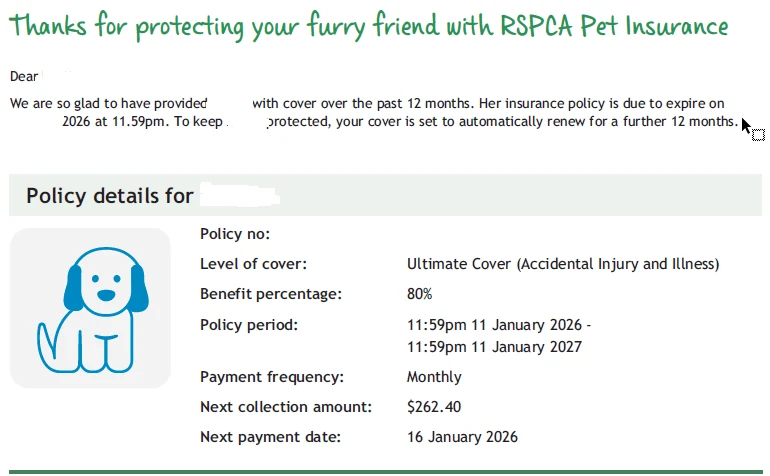
Her premium was around $100 a month when she was a puppy. Here’s what happened once she got older:
| Policy year starting | Monthly premium |
|---|---|
| January 2022 | $110 |
| January 2024 | $160 |
| January 2025 | $200 |
| January 2026 | $262.40 |
That’s well over double in four years, for the same dog on the same cover. All up I’ve paid roughly $25,000 in premiums.
Over those years I’ve claimed for ear infections, rat bait she found on a farm, chocolate she got into, a broken nail, and a paw cut on glass. The bills varied a lot. Each time, RSPCA paid back about 80%, which is what my policy says it pays.
If you’ve read the Reddit threads and Trustpilot reviews, you’ll know the price rises are the most common complaint. In my experience that complaint is fair. The claims side never gave me trouble. The renewal letters were what hurt. I’ve written more about whether the whole 14 years was worth it in my guide to whether pet insurance is worth it in Australia.
What happened to RSPCA pet insurance in 2026
On 1 April 2026, the RSPCA moved to a new insurance partner. From that date, new RSPCA Pet Insurance policies are underwritten by Pacific International Insurance. That’s the same underwriter behind Pet Circle Insurance and PetsOnMe, the two insurers I link to on this site.
Policies that started on or before 31 March 2026, like Minka’s, didn’t move with it. They’re still underwritten by Hollard and run by PetSure, the RSPCA’s previous partners. And according to the RSPCA’s own website, when those older policies come up for renewal (up to 31 March 2027), they’ll be switched to another brand, such as Buddy Pet Insurance or Real Pet Insurance.
The RSPCA is blunt about Buddy. It says Buddy Pet Insurance isn’t RSPCA Pet Insurance, isn’t endorsed by the RSPCA, and doesn’t support its animal welfare work.
So if you’ve been with RSPCA for years, the policy you renew into may carry a different name, even though you never chose to leave.
If you’re an existing RSPCA customer: what are your options?
My own renewal is due on 11 January 2027, so I’m working through this right now. As far as I can tell from the RSPCA’s site, there are three paths.
Let it renew. Your policy moves to the new brand at renewal. Read that renewal letter closely, because the name on it, the premium and the policy wording are what you’ll be living with.
Switch to the new RSPCA PetShield. The RSPCA pitches PetShield as cover “comparable to your original policy”. For people switching from an older RSPCA policy, it promises no new exclusion periods for conditions already covered, and cover for previously claimed conditions up to your existing annual limit and benefit percentage. You need your current Certificate of Insurance to switch.
Switch to PetFlex. The RSPCA’s customisable plan, with the same switching promises, plus more options (below).
For an older dog, the one thing I’d say is: don’t let cover lapse while you decide. Once a policy ends, anything your dog has been treated for can become a pre-existing condition with a new insurer. That’s the real risk here, much more than the name on the letter.
The new RSPCA Pet Insurance, for new customers
If you’re starting fresh, there are now two products, both underwritten by Pacific International.
PetFlex is the customisable one. You can choose an annual limit up to $35,000, an excess from $0 to $500, and 60%, 70%, 80% or 90% back, with no sub-limits. You can add optional extras such as dental illness, supportive therapies, behavioural conditions and routine care. Two catches worth knowing. Dental illness cover has to be added before your dog turns 3. And BOAS, the breathing condition in flat-faced breeds, isn’t covered unless an assessment is completed and approved.
PetShield accepts new dogs up to their 16th birthday, which is unusual. Pet Circle, PetsOnMe’s Classic and Deluxe plans, and RSPCA’s own PetFlex all stop taking new dogs at around 9. If you’ve got an older dog with no cover, it’s one of the few options left. My guide to pet insurance for older dogs covers the others.
New customers currently get the first two months free. I haven’t quoted the new products, so I can’t give you a price. If you want a sense of what a policy costs at different ages, my guide to how much pet insurance costs in Australia has real quotes for five breeds from the two insurers that share RSPCA’s new underwriter.
Is RSPCA pet insurance good? My verdict
For me, yes. Fourteen years, five kinds of claim, every one paid back at about 80%, and no real issues.
What I’d weigh before signing up:
- The price will climb. Mine went from $110 to $262.40 a month in four years. Budget for that, whichever insurer you pick.
- If you’re an existing customer, check your renewal letter. The policy may be moving to a different brand.
- The new RSPCA products are a different company underneath. Fourteen good years with Hollard and PetSure tells you nothing certain about Pacific International’s claims handling. It’s the same underwriter as Pet Circle and PetsOnMe, though, so you’re choosing between brands and options more than between claim departments.
- No affiliate link. I don’t earn anything if you choose RSPCA.
I earn a small commission if you purchase through these links, at no extra cost to you.
If you’d like to compare RSPCA’s new cover with the two other brands on the same underwriter, these are the two I link to:
Frequently asked questions
What is happening with RSPCA pet insurance?
On 1 April 2026 the RSPCA moved to a new insurance partner, Pacific International Insurance. New policies from that date are underwritten by Pacific International. Policies that started before then stay with Hollard and PetSure, and the RSPCA says they’ll be switched to another brand, such as Buddy Pet Insurance, at renewal.
What is Buddy Pet Insurance?
Buddy Pet Insurance is a brand offered by the RSPCA’s previous insurance partner. Older RSPCA policies are being moved to it at renewal. The RSPCA says Buddy isn’t RSPCA Pet Insurance, isn’t endorsed by the RSPCA and doesn’t support its animal welfare work.
Who underwrites RSPCA pet insurance?
Policies that started on or after 1 April 2026 are underwritten by Pacific International Insurance, the same underwriter as Pet Circle Insurance and PetsOnMe. Policies that started before then are underwritten by The Hollard Insurance Company and administered by PetSure.
Does RSPCA pet insurance cover older dogs?
Yes. RSPCA’s PetShield accepts new dogs up to their 16th birthday, which is far later than most comprehensive policies. Neither PetShield nor PetFlex has an age limit at renewal.
How much does RSPCA pet insurance cost?
It depends on your pet, your postcode and the options you choose. My own senior Shih Tzu is on RSPCA Ultimate Cover at 80% back, and her premium for the year starting January 2026 is $262.40 a month. It was $110 a month four years earlier.
Does RSPCA pet insurance cover dental?
On the new PetFlex plan, dental illness is an optional extra rather than standard cover, and it has to be added before your dog turns 3. Routine teeth cleaning isn’t covered on PetFlex unless it’s part of treating a covered dental illness. PetShield’s optional routine care benefit does include teeth cleaning.